
Business accounting for beginners: Enroll in $30 online course

Unfortunately, InDinero doesn’t have many integration options, but if you already use the software they integrate with, it’s a very robust solution. Online services may offer one-on-one meetings, but you might have to pay more. If you want a higher level of support in the future, such as chief financial officer or CFO-style services, consider choosing a bookkeeping service that will allow you to upgrade later. For pricing, we considered whether a service offers a free trial or a free version of its software as well as the affordability of its lowest and highest price tiers. Bookkeeper360 is best for businesses that occasionally need bookkeeping services as well as those that want integrations with third-party tools. We’re firm believers in the Golden Rule, which is why editorial opinions are ours alone and have not been previously reviewed, approved, or endorsed by included advertisers.
Why You Can Trust Forbes Advisor Small Business
We offer an accounting newsletter with timely tips for growing your business. The Ascent is a Motley Fool service that rates and reviews essential products for your everyday money matters. Compare features, pricing, and expert reviews for your business software needs – all in one place. Many or all of the products featured here are from our partners who compensate us. This may influence which products we write about and where and how the product appears on a page.
- Every virtual bookkeeping service should have an option that includes this.
- We weighted each category equally to calculate our star ratings, and we also considered our accounting expert’s opinion and advice when ranking our top brands.
- We’ll keep you updated with the relevant financial data your business requires to run smoothly, limit expenses, and capitalize on new opportunities.
- Another bonus is that you get to communicate with your bookkeeping service team via chat easily.
inDinero: Best for established startups
Answer a few questions about what’s important to your business and we’ll recommend the right fit. The most common mistakes are mixing personal and business finances, leaving bookkeeping solutions taxes to the last minute, missing out on deductions, and not retaining records for long enough. Offers add-ons for catch-up bookkeeping and specialized bookkeeping.
Decimal: Best for project-based businesses

Very small businesses can use it for basic money management, like sending invoices, monitoring financial accounts, accepting payments, and tracking income and expenses. More complex companies can add advanced tools that include projects and proposals, mileage and time tracking, and reports. As an online cloud-based accounting https://www.bookstime.com/ software, QuickBooks Online was made specifically for non-accountants (unlike the clunkier QuickBooks Desktop, which was made for accountants). Plus, if you spend more time traveling to on-site jobs and less time sitting in front of a computer, QuickBooks Online includes a fantastic mobile accounting app.
Best Online Bookkeeping Services
- Pilot is a financial services firm that provides bookkeeping, tax, and CFO advisory services for startups and small businesses.
- A downside of Bench is that it specializes in cash-basis accounting, although there is a custom accrual accounting plan on the Pro plan.
- This service is ideal for business owners who want to get their bookkeeping in order but don’t have the time or resources to do it themselves.
- All of your bank and credit card transactions automatically sync to QuickBooks to help you seamlessly track income and expenses.
- Nearly 70% of business owners who have been there, done that, recommend writing a business plan before you start a business.
During our research process, we surveyed 200 professionals who have used accounting software and/or services. Below are the features they deemed as the most important to consider as you choose a provider. You choose which QuickBooks Online plan you want, and then you tack on QuickBooks Live for $300 more per month. This provides a middle ground between managing everything yourself with software and handing over the reins completely to an accountant. You still have access to your finances in the software, but you also have someone to help you use the software properly and prepare for tax season.
Along with unlimited users, it lets you add unlimited bank accounts and credit cards for easier (and more accurate) bank reconciliation. Its chart of accounts, journal entry generation, and multi-business management make it a good fit for small and midsize businesses alike. QuickBooks Online sets the standard for bookkeeping software with thorough, easy-to-understand financial reporting. Its cheapest plan includes all the financial reporting basics (profit and loss statements, balance sheets, and cash flow statements), plus sales tax and mileage tracking. Pricier plans include reports for accounts receivable and payable, budgeting, inventory, sales, profitability, and more. Bench is an online bookkeeping service platform that uses proprietary software to handle your business’ books.
What Is Net Profit Margin? Formula for Calculation and Examples

Last year Trisha’s net sales were $1,000,000 and her net income was $100,000. Hence, comparisons between companies operating in different industries are not recommended and are likely to lead to misleading conclusions. It is recommended to compare only companies in the same sector with similar https://www.kelleysbookkeeping.com/tips-for-finding-the-right-tax-accountant/ business models. Many or all of the products featured here are from our partners who compensate us. This influences which products we write about and where and how the product appears on a page. Mary Girsch-Bock is the expert on accounting software and payroll software for The Ascent.

Net Profit Margin vs. Gross Profit Margin
For practically all profit margins, the general “plug-in” formula is as follows. By comparing a profit metric to revenue, the profitability of a company after deducting certain types of expenses can be analyzed, which helps determine where a company’s spending is concentrated. A Profit https://www.kelleysbookkeeping.com/ Margin measures the percentage of a company’s revenue that remains once certain expenses have been deducted. That’s why it’s helpful to calculate your profit margin separately for each product that you sell, which will allow you to see how well or how poorly each product is performing.
Supercharge your skills with Premium Templates
After almost a decade of experience in public accounting, he created MyAccountingCourse.com to help people learn accounting & finance, pass the CPA exam, and start their career. We’ll now move on to a modeling exercise, which you can access by filling out the form below. From our retail example, we can see how inventory and direct labor comprised the majority of Walmart’s total core expenses. In particular, depreciation and amortization represent non-cash accounting conventions used to match capex spend with the corresponding revenue generated under the matching principle. When it comes to company-to-company comparisons, isolating the core operations of each company is important – otherwise, the values would be skewed by non-core, discretionary items. In other words, 60 cents of every dollar your business makes in sales (after discounts and returns) is available for you to use to run your business.
How to Calculate Profit Margin in Excel
Professional services industries — like accounting and attorneys — have lower overhead costs which result in high profit margins. Overall, though, a 5% margin is low, a 10% margin is average, and a 20% margin is good or high. So try to target a net profit margin between 15% and 20% in your business. Profitability metrics are important for business owners because they highlight points of weakness in the operational model and enable year-to-year performance comparison. For investors, a company’s profitability has important implications for its future growth and investment potential.
This margin calculator will be your best friend if you want to find out an item’s revenue, assuming you know its cost and your desired profit margin percentage. In general, your profit margin determines how healthy your company is — with low margins, you’re dancing on thin ice, and any change for the worse may result in big trouble. Keep reading to find out how to find your profit margin and what is the gross margin formula. Profit margin is one of the simplest and most widely used financial ratios in corporate finance. A company’s profit is calculated at three levels on its income statement, each with corresponding profit margins calculated by dividing the profit figure by revenue and multiplying by 100. Creditors and investors use this ratio to measure how effectively a company can convert sales into net income.
Your profit margin shows how much money you make from every dollar of your gross revenue. When you improve your profit margin, you actually make more money without needing to increase sales or gross revenue. By dividing operating profit by revenue, this mid-level profitability margin reflects the percentage of each dollar that remains after 3 common types of manufacturing costs payment for all expenses necessary to keep the business running. The net profit margin formula divides the net income of a company by the revenue generated in the coinciding period. For example, a company can have growing revenue, but if its operating costs are increasing faster than revenue, then its net profit margin will shrink.
Below is a video explanation from CFI’s Financial Analysis Fundamentals Course of how net profit margin is calculated and what it means when analyzing a company’s performance. There are four primary ways to increase gross profit margin, which by extension increases net profit margin. If you currently have a sales mix, meaning you sell multiple products, it can be helpful to calculate the margin mix for all of your products individually.
Profit margin is a percentage that is based on the amount of revenue left over after some or all business-related expenses have been deducted. Whether you’re a one-person operation, or employ hundreds of people, knowing how to calculate and understand profit margin will go a long way toward growing your business, no matter what stage your business is in. When you buy in bulk, you pay less on average per item, which further decreases expenses and increases the profit made on each sale. But to improve your profit margins, you also need to know how much you are spending. If we divide each net income figure by the revenue amount, we arrive at the net profit margin for all three companies.
- In addition to those mentioned before, they searched for profit calculator, profit margin formula, how to calculate profit, gross profit calculator (or just gp calculator), and even sales margin formula.
- Pocket as little as possible, or your business will suffer in the long term!
- It’d be inappropriate to compare the margins for these two companies, as their operations are completely different.
- If we divide each net income figure by the revenue amount, we arrive at the net profit margin for all three companies.
- Also, a high net profit margin does not necessarily translate to high cash flows.
- But when you focus on ways to increase customer retention, you can continue to make sales to the same people over and over without the expense of lead generation and conversion.
Profit margins that are independent of discretionary decisions, such as the capital structure and taxes (i.e. jurisdiction-dependent), are most useful for peer comparisons. Each type of profit margin serves a distinct purpose and when used in conjunction with the others, a far more comprehensive understanding of the underlying company can be obtained. When someone refers to profit margin, they are usually talking about the bottom line, or net profit margin.
Operating profit is a slightly more complex metric, which also accounts for all overhead, operating, administrative, and sales expenses necessary to run the business on a day-to-day basis. While this figure still excludes debts, taxes, and other nonoperational expenses, it does include the amortization and depreciation of assets. When analyzing a company a good analyst will look at a wide range of ratios, financial metrics, and other measures of performance. Below is a list of commonly used performance metrics that analysts often consider in order to compile a complete and thorough analysis of a business. As you can see from the screenshot, if you enter a company’s revenue, cost of goods sold, and other operating expenses you will automatically get margins for Gross Profit, EBITDA, and Net Profit. EBIT (earnings before interest and taxes) is the same thing as Operating Profit; EBITDA is slightly more refined, closer to Net Profit.
You may find it easier to calculate your gross profit margin using computer software. Before you sit down at the computer to calculate your profit, you’ll need some basic information, including revenue and the cost of goods sold. That’s because profit margins vary from industry to industry, which means that companies in different sectors aren’t necessarily comparable. So, for example, a retail company’s profit margins shouldn’t be compared to those of an oil and gas company. The former is the ratio of profit to the sale price, and the latter is the ratio of profit to the purchase price (cost of goods sold).
Many businesses regularly eliminate low-performing inventory or change their service offerings. But cutting low performers will lower your costs and increase your sales, which will raise your profit margin as well. Is there software you can use to collect and organize customer information? Can you use tracking software to manage shipping data and customer notifications? Automating some steps in the process or finding other ways to increase efficiency can save both time and money, allowing you to make more sales in the same amount of time and increase your profit margin per sale.
If we divide each metric by revenue, we arrive at the following profit margins for our company’s operating performance in 2021. As mentioned earlier, Salesforce is an example of a software company with high gross margins but with substantial operating costs, especially for sales & marketing. To provide some brief examples, software companies are well-known for exhibiting high gross margins, yet sales & marketing expenses often cut into their profitability significantly. The net profit margin ratio is used to describe a company’s ability to produce profit and to consider several scenarios, such as an increase in expenses which is deemed ineffective. If you are a business owner, improving your profit margin is an important part of growing your company.
How to Calculate Profit Margin Formula & Examples

The net profit margin ratio is used to describe a company’s ability to produce profit and to consider several scenarios, such as an increase in expenses which is deemed ineffective. Many businesses regularly eliminate low-performing inventory or change their service offerings. But cutting low performers will lower your costs and increase your sales, which will raise your profit margin as well. Is there software you can use to collect and organize customer information? Can you use tracking software to manage shipping data and customer notifications? Automating some steps in the process or finding other ways to increase efficiency can save both time and money, allowing you to make more sales in the same amount of time and increase your profit margin per sale.

How to Calculate Margin: A Guide
For instance, while earning $1 million in revenue is great, if your cost of goods sold is $1.1 million, you’re losing money. Likewise, if after expenses, you end up with a profit margin of 1%, any market changes, decrease in sales, or economic downturn can severely affect your business. Whether you’re calculating your profit margin to complete financial projections or create a business budget, you also need to understand what those results mean. Here are just a few things that your gross profit margin or net profit margin can tell you about your business.
Net Profit Margin Template
The operating profit margin, aka the EBIT margin, is more restrictive than the gross profit margin but less than the net profit margin. It expresses the proportion of revenue the company earns from operations before deducting interest and taxes. Gross profit measures a company’s total sales revenue minus the total cost of goods sold (or services performed). Net profit margin also subtracts other expenses, including overhead, debt repayment, and taxes.
Operating profit margin
The infamous bottom line, net income, reflects the total amount of revenue left over after all expenses and additional income streams are accounted for. This includes not only COGS and operational expenses, as referenced above, but also payments on debts, taxes, one-time expenses or payments, and any income from investments or secondary operations. There are three other types of profit margins that are helpful when evaluating a business. Tracking profit, along with revenue and expenses, is key to making informed financial decisions to keep the business running. Because the profit margin of your business allows you to measure its progress and can help determine its success, it’s important to understand how it’s calculated and how it can be improved. Net profit is calculated by deducting all company expenses from its total revenue.
Increase Efficiency
- It is common to see headlines like “ABC Research warns on declining profit margins of American auto sector,” or “European corporate profit margins are breaking out.”
- Profit margins across different industries vary as one number may be considered a high profit margin in one industry but low in another.
- Management may reduce long-term expenses (such as research and development) to increase their profit in the short-term.
- In addition, this type of financial analysis allows both management and investors to see how the company stacks up against the competition.
To keep sales prices low, they must move jobs to lower-cost workers in Mexico, China, or other foreign countries. Variable costs are any costs incurred during a process that can vary with production rates (output). If accrual principle overview how to accrue revenues and expenses you don’t currently use templates for your financial statements, you can use these free Balance Sheet and Income Statement templates. Using templates will allow you to calculate these margins for new data quickly.
A high gross profit margin means you have more money available to run your business. A high net profit margin means you have more money available to distribute to owners or shareholders in the business. Now you have all the information you need to calculate your business’s operating profit margin. Sometimes this is unavoidable; you will need to pay for supplies, website hosting, employee salaries, and many other expenses. But by tracking your expenses, you’ll be able to identify unnecessary expenses that can be trimmed to increase your profit margin.
By using a tool like Layer, you can enjoy additional benefits, like multi-platform and multi-format synchronization, scheduled updates, and full control over access to your data. Profit margins are some of the most commonly used metrics in the analysis of a company’s profitability, together with other financial ratios. Since the term profit is rather broad, specific ratios focus on different profit categories. Technology companies like Microsoft and Alphabet have high double-digit quarterly profit margins compared to the single-digit margins achieved by Walmart and Target. However, that does not mean Walmart and Target did not generate profits or were less successful businesses compared to Microsoft and Alphabet. From a billion-dollar corporation to an average Joe’s sidewalk hot dog stand, profit margin is widely used by businesses across the globe.

Once you know your gross profit you need to subtract your operating expenses from it to get your operating income number. This is how much you pay for rent, utilities, payroll and https://www.quick-bookkeeping.net/the-average-american-s-charitable-donations/ everything except income taxes and interest. You’ll also exclude draws or distributions to the owners or shareholders of the company from your operating expenses calculation.
These profit margins may also assist companies in creating pricing strategies for products or services. Companies base their prices on the costs to produce their products and the amount of profit accept payments with cash app pay they are trying to turn. The profit margin is critical to a free-market economy driven by capitalism. The margin must be high enough when compared with similar businesses to attract investors.
For example, retail stores want to have a 50% gross margin to cover costs of distribution plus return on investment. Each entity involved in the process of getting a product to the shelves doubles the price, leading retailers to the 50% gross margin to cover expenses. In the next section, you have examples of the three main profit margin ratios calculated directly using the free Income Statement template. A look at stock returns between 2006 and 2012 shows similar performances across the four stocks, although Microsoft and Alphabet’s profit margins were way ahead of Walmart and Target’s during that period. Since they belong to different sectors, a blind comparison based solely on profit margins would be inappropriate.
Having said that, you can use a scale of how a business is doing based on its profit margin. A profit margin of 20% indicates a company is profitable, while a margin of 10% is said to be average. As a business owner, it’s important for you to understand how to calculate your profit margin.
Other limitations include the possibility of misinterpreting the profit margin ratio and cash flow figures. A low net profit margin does not always indicate a poorly performing company. Also, a high net profit margin does not necessarily translate to high cash flows. We believe everyone https://www.quick-bookkeeping.net/ should be able to make financial decisions with confidence. When you buy in bulk, you pay less on average per item, which further decreases expenses and increases the profit made on each sale. These could be for daily operations, to make goods, or even to ship products to customers.
Using profit margin is an easy way to compare your business with others in your industry. Profitability metrics are important for business owners because they highlight points of weakness in the operational model and enable year-to-year performance comparison. For investors, a company’s profitability has important implications for its future growth and investment potential. In addition, this type of financial analysis allows both management and investors to see how the company stacks up against the competition. Creditors and investors use this ratio to measure how effectively a company can convert sales into net income.
Net Profit Margin Calculator

Profit margin is one of the simplest and most widely used financial ratios in corporate finance. A company’s profit is calculated at three levels on its income statement, each with corresponding profit margins calculated by dividing the profit figure by revenue and multiplying by 100. According to its cash flow statement, the net income of company A equaled $155,000. Company B earned a net income of $20,000, while Company C generated a loss of $-75,000.
Best Free Accounting Software for Small Businesses
Profit margin is a common measure of the degree to which a company or a particular business activity makes money. Expressed as a percentage, it represents the portion of a company’s sales revenue that it gets to keep as a profit, after subtracting all of its costs. For example, if a company reports that it achieved a 35% profit margin during the last quarter, it means that it netted $0.35 from each dollar of sales generated.
Types of Profit Margins
Since most of the time generating additional revenues is much more difficult than cutting expenses, managers generally tend to reduce spending budgets to improve their profit ratio. The most common and widely used type of profit margin is net profit margin, which accounts for all of a company’s costs, both direct and indirect. A look at stock returns between 2006 and 2012 shows similar performances across the four stocks, although Microsoft and Alphabet’s profit margins were way ahead of Walmart and Target’s during that period. Since they belong to different sectors, a blind comparison based solely on profit margins would be inappropriate. Profit margin comparisons between Microsoft and Alphabet, and between Walmart and Target are more appropriate. Management may reduce long-term expenses (such as research and development) to increase their profit in the short-term.
Understanding the Ratio

As you can see, Trisha only converted 10 percent of her sales into profits. Contrast that with this year’s numbers of $800,000 of net sales https://www.bookkeeping-reviews.com/ and $200,000 of net income. The return on sales ratio is often used by internal management to set performance goals for the future.
The overall success of your business
Using profit margin is an easy way to compare your business with others in your industry. So the difference is completely irrelevant for the purpose of our calculations — it doesn’t matter in this case if costs include marketing or transport. Most of the time people come here from Google after having searched for different keywords. In addition to those mentioned before, they searched for profit calculator, profit margin formula, how to calculate profit, gross profit calculator (or just gp calculator), and even sales margin formula.
Gross profit measures a company’s total sales revenue minus the total cost of goods sold (or services performed). Net profit margin also subtracts other expenses, including overhead, debt how to account for invoice financing in xero repayment, and taxes. However, the net profit margin is not merely the amount of cash left in the company after all costs (e.g., salaries, utilities, or depreciation) are covered.
- That’s why it’s helpful to calculate your profit margin separately for each product that you sell, which will allow you to see how well or how poorly each product is performing.
- Professional services industries — like accounting and attorneys — have lower overhead costs which result in high profit margins.
- This margin calculation can help you determine which products are the most profitable.
- Access and download collection of free Templates to help power your productivity and performance.
The gross profit margin compares gross profit to total revenue, reflecting the percentage of each revenue dollar that is retained as profit after paying for the cost of production. Unless a company’s profit is negative (i.e., it generates a loss), the net profit margin formula should produce a value from 0% to 100%. You may be tempted to think that the higher your net profit margin, the better for you.
My Accounting Course is a world-class educational resource developed by experts to simplify accounting, finance, & investment analysis topics, so students and professionals can learn and propel their careers. It is recommended to compare only companies in the same sector with similar business models. Editorial content from The Ascent is separate from The Motley Fool editorial content and is created by a different analyst team.
As a financial analyst, this is important in day-to-day financial analysis. Calculating your profit margin can provide you with a great deal of information on the financial health of your business. Be sure to track profit margin regularly, and avoid comparing your profit margins against those of businesses that https://www.bookkeeping-reviews.com/difference-between-balance-b-f-and-balance-c-f/ aren’t in your industry. For instance, while earning $1 million in revenue is great, if your cost of goods sold is $1.1 million, you’re losing money. Likewise, if after expenses, you end up with a profit margin of 1%, any market changes, decrease in sales, or economic downturn can severely affect your business.
Producers of luxury goods and high-end accessories can have a high profit potential despite low sales volume, compared with the makers of lower-end goods. A very costly item, like a high-end car, may not even be manufactured until the customer has ordered it, making it a low-expense process for the maker, without much operational overhead. Investors looking at funding a particular startup may want to assess the profit margin of the potential product/service being developed.
For example, information services in the U.S. reveal, on average, a fairly high net profit margin ratio of about 13.4%. At the same time, the shipbuilding industry is characterized by a negative value of this indicator, -1.8%. There are many different metrics that analysts and investors can use to help them determine whether a company is financially sound.
Software or gaming companies may make a substantial investment initially in developing a new software product or video game but cash in big later by selling millions of copies with very little additional expense. Similarly, patent-secured businesses like pharmaceutical companies may incur high research costs initially, but reap high profit margins when they bring a new drug to market. From a billion-dollar corporation to an average Joe’s sidewalk hot dog stand, profit margin is widely used by businesses across the globe.
It’s important to keep an eye on your competitors and compare your net profit margins accordingly. Additionally, it’s important to review your own business’s year-to-year profit margins to ensure that you are on solid financial footing. Margins for the utility industry will vary from those of companies in another industry. According to a New York University analysis of industries in January 2022, the average profit margins range from nearly 29% for railroad transportation to almost -20% for renewable and green energy. The average net profit margin for general retail sits at 2.65%, while the average margin for restaurants is 12.63%.
Because companies express net profit margin as a percentage rather than a dollar amount, it is possible to compare the profitability of two or more businesses regardless of size. Profit margin is a measure of how much money a company is making on its products or services after subtracting all of the direct and indirect costs involved. Profit margin has its limitations, however, in terms of comparing companies. Businesses with low-profit margins, like retail and transportation, will usually have high turnaround and revenue, which can mean overall high profits despite the relatively low profit margin figure. High-end luxury goods, by comparison, may have low sales volume, but high profits per unit sold.
Opportunity Cost Explained: Insights for Informed Decisions

Assume that a business has $20,000 in available funds and must choose between investing the money in securities, which it expects to return 10% a year, or using it to purchase new machinery. No matter which option the business chooses, the potential profit that it gives up by not investing in the other option is the opportunity cost. Opportunity cost is often overshadowed by what are known as sunk costs.
Learning Objectives
Money that a company uses to make payments on its bonds or other debt, for example, cannot be invested for other purposes. So the company must decide if an expansion or other growth opportunity made possible by borrowing would generate greater profits than it could make through outside investments. While opportunity costs can’t be predicted with total certainty, taking them into consideration can lead to better decision making. To go deeper into opportunity cost calculation, use the advanced mode, and follow the formulas below. Keep reading to find more about the assumptions this tool uses, how to calculate opportunity cost, and the opportunity cost definition.
Watch Articles
You’d also face an opportunity cost with your vacation days at work. If you use some of them now with your spare $1,000 you won’t have them next year (assuming your employer lets you roll them over from year to year). Pete Rathburn is a copy editor and fact-checker with expertise in economics and personal finance and over twenty years of experience in the classroom. Our writers and editors used an in-house natural language generation platform to assist with portions of this article, allowing them to focus on adding information that is uniquely helpful. The article was reviewed, fact-checked and edited by our editorial staff prior to publication. Take your learning and productivity to the next level with our Premium Templates.
Evaluating Business Decisions

Under those rules, only explicit, real costs are subtracted from total revenue. Suppose, for example, that you’ve just received an unexpected $1,000 bonus at work. You could simply spend it now, such as on a spur-of-the-moment vacation, or invest it for a future trip. For example, if you were to invest the entire amount in a safe, one-year certificate of deposit at 5%, you’d have $1,050 to play with next year at this time.
Consider a young investor who decides to put $5,000 into bonds each year and dutifully does so for 50 years. Assuming an average annual return of 2.5%, their portfolio at the end of that time would be worth nearly $500,000. Although this result might seem impressive, it is less so when you consider the investor’s opportunity cost. If, for example, time period assumption they had instead invested half of their money in the stock market and received an average blended return of 5% a year, their portfolio would have been worth more than $1 million. Take, for example, two similarly risky funds available for you to invest in. The opportunity cost of the 10 percent return is forgoing the 8 percent return.
The opportunity cost attempts to quantify the impact of choosing one investment over another. Your alternative is to keep using your current vehicle for the next two years, and invest money with a 3 % rate of return. There is a 22 % tax on capital gains, and the inflation rate is 1.5 %. Your interest is compounded monthly – that means your earned interest will be added to your account each month, and next month your interest will be calculated on that new, larger amount.
- Opportunity cost is important to consider when making many types of decisions, from investing to everyday choices.
- Investors might use the historic returns on various types of investments in an attempt to forecast their likely returns.
- One of the most dramatic examples of opportunity cost is a 2010 exchange of 10,000 bitcoins for two large pizzas—at the time worth about $41.
- “Expert verified” means that our Financial Review Board thoroughly evaluated the article for accuracy and clarity.
That’s a real opportunity cost, but it’s hard to quantify with a dollar figure, so it doesn’t fit cleanly into the opportunity cost equation. You chose to read this article instead of reading another article, checking your Facebook page, or watching television. Your life is the result of your past decisions, and that, essentially, is the definition of opportunity cost.
As such, it is important that this cost is ignored in the decision-making process. Say a shoe manufacturer has the option of investing in new equipment that is expected to provide a return of roughly 9% the first year. Alternatively, the company can put its money into securities that generate income of 3% a year. In economics, risk describes the possibility that an investment’s actual and projected returns will be different and that the investor may lose some or all of their capital. Opportunity cost reflects the possibility that the returns of a chosen investment will be lower than the returns of a forgone investment.
You may also find it useful to go through an opportunity cost example, which provides you with a step-by-step model you can adjust to your own needs. The decision in this situation would be to continue production https://www.kelleysbookkeeping.com/ as the $50 billion in expected revenue is still greater than the $40 billion received from selling the land. The $30 billion initial investment has already been made and will not be altered in either choice.
Risk evaluates the actual performance of an investment against its projected performance. It focuses solely on one option and ignores the potential gains from other options that could have been selected. In contrast, opportunity cost focuses on the potential for lower returns from a chosen investment compared to a different investment that was not chosen. For example, a stock with a potential 10 percent annual return has more risk than investing in a CD with a sure-fire 5 percent annual return. So the opportunity cost of taking the stock is the CD’s safe return, while the cost of the CD is the stock’s potentially higher return and greater risk. The stock’s risk and potential for loss may make the lower-yielding investment a more attractive prospect.
As a result, the decision rule then changes from choosing the project with the highest NPV to undertaking the project if NPV is greater than zero. It makes intuitive sense that Charlie can buy only a limited number of bus tickets and burgers with a limited budget. While opportunity costs can’t be predicted with absolute certainty, they provide a way for companies and individuals to think through their investment options and, ideally, arrive at better decisions. Sunk costs should be irrelevant for future decision making, while opportunity costs are crucial because they reflect missed opportunities. That’s not to say that your past decisions have no effect on your future decisions, of course. You’ll still have to pay off your student loans whether or not you continue in your chosen field or decide to go back to school for more education.
For example, a person could spend $12 watching a matinee movie, or they could use it to buy lunch. If they opt for the former, they may not have money for the latter, and vice versa. On the other hand, “implicit costs may or may not have been incurred by forgoing a specific action,” says Castaneda. “Explicit costs are those that are incurred when taking a specific course of action,” says Bob Castaneda, program director of Walden University’s College of Management of Technology. Opportunity costs can be easily overlooked because sometimes the benefits are unrealized, and therefore, hidden from view.
Trade-offs take place in any decision that requires forgoing one option for another. So, if you chose to invest in government bonds over high-risk stocks, there’s a trade-off in the decision that you chose. Opportunity cost attempts to assign a specific figure to that trade-off. If you are wondering how to calculate https://www.kelleysbookkeeping.com/what-is-inventory-shrinkage-and-how-to-prevent-it/ opportunity cost, check the sections below to find its formula and some more examples. Opportunity cost is a term that refers to the potential reward that you forgo when choosing one option over the next-best alternative. Any effort to predict opportunity cost must rely heavily on estimates and assumptions.
DCF Model: Full Guide, Excel Templates, and Video Tutorial
Regardless of which method is used, the terminal value would be discounted to the present day to get its net present value. To understand the difference between levered and unlevered free cash flow, please watch our video from our DCF Modelling Course, which explores this topic. Investors’ required rate of return (as discussed above) generally relates to the risk of the investment (using the Capital Asset Pricing Model). Therefore, the riskier an investment, the higher the required rate of return and the higher the cost of capital.
You could also search for industry data from companies like IDC, Gartner, and Forrester, but it’s not necessary for a quick analysis of a mature company. One place where the book value-as-proxy-for-market-value can be dangerous is with “non-controlling interests.” Non-controlling interests are usually understated on the balance sheet. If they are significant, it is preferable to apply an industry multiple to better reflect their true value. Like other models, such as the financial and accretion dilution models, there are multiple steps to create a DCF model. Watch CFI’s video explanation of how the formula works and how you can incorporate it into your financial analysis. The change in working capital, which includes accounts receivable, accounts payable, and inventory, must be calculated and added or subtracted depending on their cash impact.
The Discounted Cash Flow Model, or “DCF Model”, is a type of financial model that values a company by forecasting its cash flows and discounting them to arrive at a current, present value. As a final touch to the model, analysts can perform sensitivity analysis to ensure the model’s reliability, similar to how financial models are tested. Essentially, changing the underlying assumptions (like those used in the financial statements) will provide a range of values that the business could be worth. The discount rate (or required rate of return) can be taken as an assumed percentage or be calculated using the weighted average cost of capital (WACC).
- This is because you can deposit the $20 you have now at a bank to earn interest which increases its value.
- This is important because a dollar today is worth more than a dollar in the future due to inflation.
- Demonstrate that you have put in the work outside of university courses to become a master in discounted cash flow modeling.
CFI is on a mission to enable anyone to be a great financial analyst and have a great career path. In order to help you advance your career, CFI has compiled many resources to assist you along the path. CFI is the official global provider of the Financial Modeling and Valuation Analyst (FMVA)® designation. If you want to take your corporate finance career to the next level, we’ve got a wide range of financial modeling resources to get you there. It’s important to pay close attention to the timing of cash flows in a DCF model, as not all the time periods are necessarily equal.
Additional Questions & Answers
The important part is that the company’s Discount Rate is closer to 5% than 10% or 15%, so we can use a range of values with 5% in the middle. If it’s 1.0, then the stock follows the market perfectly and goes up by 10% when the market goes up dcf model training by 10%; if it’s 2.0, the stock goes up by 20% when the market goes up by 10%. The Equity Risk Premium (ERP) is the percentage the stock market is expected to return each year, on average, above the yield on these “safe” government bonds.
If the cost of equity is 8% and the cost of debt is 5%, we calculate the weighted average, 50% of 8% plus 50% of 5% to determine the WACC. Is that market price justified based on the company’s fundamentals and expected future performance (i.e. its intrinsic value)? Another problem with this model is that it assumes both the discount rate and growth rate of an organization are fixed, which is hardly ever the case in reality. Constant fluxes in the economy and developments within an organization would lead to increases and decreases in both these rates. We discount future cash flow because the value of cash appreciates over time, which means that money received today is worth more than money received in the future. CFI is the global institution behind the financial modeling and valuation analyst FMVA® Designation.
How much experience do I need to do this Guided Project?
While the discounted cash flow model is very useful as it can quantify a sophisticated deal by providing investors with a number representing the worth of a company or project, it is not without disadvantages. Once most of the income statement is in place, then it’s time to forecast the capital assets. PP&E is often the largest balance sheet item, and capital expenditures (CapEx), as well as depreciation, need to be modeled in a separate schedule.
There is often a “stub period” at the beginning of the model, where only a portion of the year’s cash flow is received. Additionally, the cash outflow (making the actual investment) is typically a spate time period before the stub is received. It requires disaggregating revenue into its various drivers, such as price, volume, products, customers, market share, and external factors. Regression analysis is often used as part of a driver-based forecast to determine the relationship between underlying drivers and top-line revenue growth. A growth-based forecast is simpler and makes sense for stable, mature businesses, where a basic year-over-year growth rate can be used. Cash flow is simply the cash generated by a business that’s available to be distributed to investors or reinvested in the business.
The problem with this approach is that you need quick access to data for comparable companies, which may be tricky without Capital IQ, FactSet, or similar services. That value today depends on how much you could earn with your money in other, similar companies in this market, i.e., your expected, average annualized returns. And if you are dealing with a rapidly changing company or a tech startup (e.g., Uber or Snap), it’s often more useful to get KPIs and financial stats from similar companies that were once growing quickly but have since matured. I’ll address this question at the end of this article, but the short answer is that the DCF model still matters – but perhaps less so for a tiny percentage of overhyped companies and less so in crazed market environments. We wrote this guide for those thinking about a career in finance and those in the early stages of preparing for job interviews.
Get The DCF Modeling Course Certification
A DCF model is a valuable tool for investors and analysts to assess the value of a company or investment. This is important because a dollar today is worth more than a dollar in the future due to inflation. The most popular method used for projecting future cash flows is the unlevered free cash flow method. When making our calculations, we assume the company has no leverage, or debt, such as interest payments or principal payments, to be included in projecting the future cash flows.
However, more often than not, we are more interested in the stock price than in this value. A discounted cash flow (DCF) model is a financial model used to value companies by discounting their future cash flow to the present value. In this guide, we’ll provide you with an overview of the components of a DCF model. This will serve as a reference tool for before or after our financial modeling course where we build a DCF model on public company. As the name suggests, a discounted cash flow model requires projections of future cash flows to discount them to a present value.
For example, having $20 today would be worth more than having $20 in the future. This is because you can deposit the $20 you have now at a bank to earn interest which increases its value. Upgrading to a paid membership gives you access to our extensive collection of plug-and-play Templates designed to power your performance—as well as CFI’s full course catalog and accredited Certification Programs.
Tax Preparation, Accounting & Quickbooks Bookkeeping Services FL, USA

We want you to be able to focus on taking care of your clients and running your business. Bookkeeping Services in Fort Lauderdale – An essential service for every business! Provides critical financial support that ensures that the business stays financially stable and profitable.
Coss Bookkeeping & Accounting

You can also ask an accountant to provide proof of their license and credentials. We keep a close look on your books so you are confident you are in good hands and you never have to ever worry about your finances. You get the same expert advice that Fortune 500 companies get but at a fraction of the cost. Your Xendoo team is always available by live chat, email, or phone call.
Top Business and Tax Strategies for Entrepreneurs – Year-End Triumph
We are life-long learners, passionate about teamwork and excellence in our respective roles, with a solution-oriented approach to challenges. We are actively seeking dedicated Accountants to join our team. We offer small businesses in Fort Lauderdale, Fla., CPA services to free you up so you can get back to why you started your business. No more mad dash to get organized for income tax day, or filing extensions when you fall behind.
All “accountants” results in Fort Lauderdale, Florida
For that reason, we do not offer a cookie-cutter solution to our clients but focus on every company’s budget constraints and bookkeeping needs. According to the American Institute of CPAs, certified public accountant (CPAs) financially advise individuals, big companies and small businesses to help them reach their financial goals. For example, they can consult you on taxes and other accounting needs.
- Life’s a beach in Fort Lauderdale—especially for small business owners who spend as little time as possible keeping their books.
- We are proud of our professional Fort Lauderdale bookkeeping services in helping you identify financial records errors and maintain accurate profit/loss and income sheets.
- Cofer Bookkeeping Services provides financial services to businesses and professionals with an emphasis on accuracy and transparency.
- You need to know exactly what those numbers mean, how they affect your business, and how to use them to control your operation.
- Here are just a few of the many industries that we serve with our dedicated bookkeeping services.
Maintain certification in both Quickbooks Online and Xero software. Xendoo and the Xero accounting platform work hand-in-hand to integrate seamlessly with virtually all https://www.bookstime.com/ of the cloud software used by Fort Lauderdale small businesses today. Use the convenient Xendoo app and online portal to access your financial data and reports anytime.
- Afterwards, he founded our company to better help business and people in the Broward County area.
- You deserve to have peace of mind knowing that your finances are in good hands.
- Our team believes in complete honesty and integrity in their services so that each of the business owners of Fort Lauderdale is one hundred percent satisfied.
- Hawkeye Bookkeeping is dedicated to helping small business with their bookkeeping needs.
- It’s no secret that good bookkeeping is the key for maintaining a successful business.
It’s like we’re right there in Fort Lauderdale making it happen with you. In some cases, BBB will not rate the business (indicated by an NR, or “No Rating”) for reasons that include insufficient information bookkeeping services fort lauderdale about a business or ongoing review/update of the business’s file. Select businesses earn BBB Accreditation by undergoing a thorough evaluation and upholding the BBB Accreditation Standards.
Ultimately, hiring a bookkeeper is a good investment for any business because it ensures that the business stays financially healthy and helps the owner make informed decisions that drive long-term success. Receive our monthly news letter with the latest tax and business information. Let us keep you posted on the latest tax planning and business management ideas. Check out the average hourly rate for accounting services in your area. Maintain accurate and consistent books for assigned customers, including recording payments, expenses, and adjustments weekly and performing monthly bank, credit card, and Balance Sheet reconciliations. Provide higher-level accounting guidance to the Xendoo Accounting team.

SMS Tax and Accounting Services, LLC offers the right balance between personal attention, reliable advice, and a wealth of experience to deliver the high quality accounting and tax services your business needs to succeed. We also work with individuals and provide income tax preparation services designed to save you money and get you your tax return quickly. Accountants may offer a package rate for weekly, monthly or annual services to reward ongoing customers. For basic monthly accounting services, an accountant might charge anywhere from $75 to $500 or more, depending on what was included in a given package, the size of the client’s business, and the complexity of work requested. Nationally, full-time staff accountants earn between $40,000 and $80,000, depending on experience and other factors. Accountants are financial professionals who have received an accounting degree from a four-year university or college.
- Accountants do not automatically have a Certified Public Accountant (CPA) designation unless they have passed the Uniform CPA Examination and received the proper license.
- This individual pays attention to details, is proactive in understanding financial statements, and is willing to expand their knowledge further.
- This role assists in maintaining financial transactions, reconciling accounts, and contributing to the overall efficiency of the accounting department.
- An accountant may charge an hourly rate when a company or individual needs their services on a short-term basis, such as when performing an audit or requesting assistance setting up a financial database or process.
- Maintain certification in both Quickbooks Online and Xero.
- Let us keep you posted on the latest tax planning and business management ideas.
Why Choose Howard CPAs Accounting Services?
5 Ways to Calculate Sales Tax

It is the most popular type of sales tax in more than 160 countries outside the United States. VAT is levied as an indirect tax anytime value is added to the production of goods or services. https://www.quick-bookkeeping.net/ All participants in the supply chain (such as wholesalers, suppliers, and manufacturers) must pay VAT, not just the last buyer, as is the case with sales tax in the United States.
How to use the sales tax calculator
Avalara can automate your multi-state sales tax returns, let you know when you’ve triggered nexus, and more. If you are a business owner and are interested in automating your sales tax calculation and reporting requirements, click here to get more information. First of all, if you’re shopping in New https://www.quick-bookkeeping.net/create-custom-invoice-templates-using-our-free/ Hampshire, Oregon, Montana, Alaska, or Delaware, the sticker price will be the total price. By basing sales tax on ZIP codes, you risk applying the wrong rates and remitting tax to the incorrect jurisdiction. Both of these errors increase your company’s risk of audit penalties, fines, and fees.
How to calculate sales tax with our online sales tax calculator
However, it also means that the tax burden might be more palpable for the ultimate consumer. Moreover, as you will see in the following, the high diversity of sales tax what is a flat rate pricing model pros and cons explained structures over U.S. states can hurt the economy through distorting consumption and investment. Imported and exported goods can be taxed in countries that impose a VAT.
How is an excise tax different from a sales tax?
Taxes like VAT can raise more money than sales taxes at a given rate. Tax evasion is more difficult with VAT because this tax is applied at every stage of a good’s production cycle. In addition, taxing is a wash sale such a bad thing the entire supply chain creates more substantial incentives to keep costs under control. Next, taxpayers must determine whether or not to claim either state and local income taxes or sales taxes.

Because sales tax can vary by state and by item, it can be difficult to predict exactly how much you’ll pay, but not nearly as hard to get a general idea. There are many ways to establish sales tax nexus — the connection between a business and a state that creates a sales tax collection requirement — and no two state sales tax laws are exactly alike. Determining which laws apply to your business is hard, but it’s a crucial step toward compliance.
- Here’s how the sales tax deduction works and how you can determine the best route for you.
- Therefore, more accurate rates are determined based on street address.
- There have been several attempts to move the US taxation system towards a consumption-based system as advocates of such a shift argue that it would encourage individuals to save more.
- In addition, taxing the entire supply chain creates more substantial incentives to keep costs under control.
- Also, there are stronger incentives to control costs when all participants involved in a supply chain are taxed.
To calculate it, convert the sales tax percentage to a decimal, then multiply it by the retail price of the product or service. The sales tax rate ranges from 0% to 16% depending on the state and the type of good or service, and all states differ in their enforcement of sales tax. In Texas, prescription medicine and food seeds are exempt from taxation. Vermont has a 6% general sales tax, but an additional 10% tax is added to purchases of alcoholic drinks that are immediately consumed.
A third of state government revenue comes from sales tax, which is second only to income tax in terms of importance. Nailing down the rates is much more complicated than the actual math used to determine how much sales tax you’ll be paying — that’s just a simple percentage. Check out this on-demand webinar on how to calculate the right sales tax rate. Therefore, the disagreement over a sales tax was a factor in the formation of the United States. A complex history of sales taxes has followed, explaining why the United States has never enacted a federal sales tax. There were a lot of issues with some earlier attempts to impose a sales tax.
The tax is typically paid by consumers at the point of sale and is calculated by multiplying the sales tax rate by the price of the good or service being purchased. When filing federal income tax, taxpayers need to choose to either take the standard deduction or itemize deductions. This decision will be different for everyone, but most Americans choose the standard deduction. Sales tax can be deducted from federal income tax only if deductions are itemized.
Direct vs Indirect Cash Flow Forecasting: Understanding the Key Differences
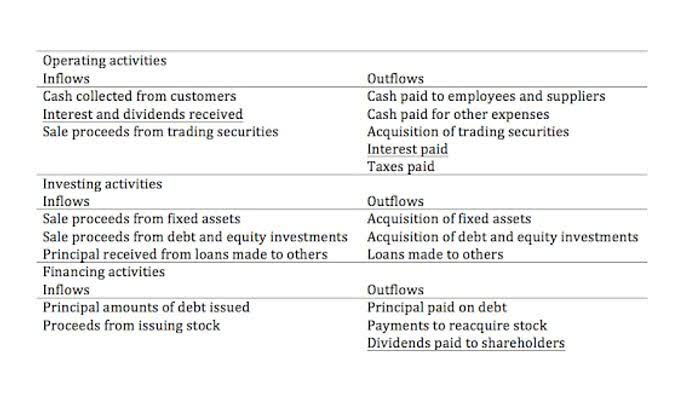
It’s also important to note that the accuracy of the indirect method is slightly less than the direct method. Using this method means that you exclude non-cash related transactions from the outset. This is a purer way of looking at your finances as it only consists of real cash moving in and out of your accounts. Both of these methods should leave you with the same figure, but they both take a different journey to get to that figure. It’s in fact the calculation that differs between the two as it draws upon different sources of data to reach the final figure.
Complexities arise since each source of cash inflows and outflows must be appropriately identified. The direct cash flow method is considered the more complicated of the cash flow methods, especially for indirect cash flow vs direct a company that utilizes accrual accounting. The accounting manager cannot use changes between assets and liabilities to measure variations in receivables and payables under the direct cash flow method.
How to Perfect the Art of Cash Flow Forecasting
The indirect method is more commonly used in practice, especially among larger firms. However, the direct approach can still be viable if the company has lots of transactions that affect cash. Accounting software can easily categorize cash transactions so that they are quickly accessible when it comes time to prepare the cash flow statement using the direct method.
The cash flow from financing and investing activities’ sections will be identical under both the indirect and direct method. The primary distinction between the direct and indirect cash flow statements is that operating activities generally report cash payments and cash receipts occurring throughout the business in the direct method. Many accountants prefer the indirect method because it is simple to prepare the cash flow statement using information from the other two common financial statements, the income statement and balance sheet. Most companies use the accrual method of accounting, so the income statement and balance sheet will have figures consistent with this method.
What is the Purpose of Direct Cash Flow Forecasting?
The cash flow from operating activities is the only section of the statement of cash flows that will change in presentation under the direct and indirect methods. Whether direct or indirect cash flow method, your cash flow statement may not always represent the information you want to share with your investors and other stakeholders. Under the direct method, operating cash inflows are derived from specific sources, such as cash sales, customer https://www.bookstime.com/ collections, and interest or dividend receipts. Similarly, operating cash outflows are identified as cash payments to suppliers, employees, and other operating expenses. Investing and financing activities are also reported separately, providing a comprehensive view of the organization’s cash flow sources and uses. To put this simply, the direct and indirect cash flow methods are the way you can figure out your business’s net cash flows.
The indirect method uses your net income as its base and comes to a figure by the use of adjustments. Whereas the direct method will only focus on the cash transactions and produces the flow from the operations of your business. The indirect method is commonly used by a number of businesses across the world. It can also be done quickly with data that is easy to gather from your accounting software.
LCPA Group LTD Experienced Fort Wayne Tax & Payroll Accountants
We are a full-service accounting firm with over 100 years of combined certified public accounting experience. We strive to provide our clients with high-quality service at a competitive price. We focus on forming and maintaining long-term personal relationships with our clients based on a foundation of trust, attention to detail, and responsiveness.
- From generating cash flow statements to handling payroll and preparing your tax returns, we are here to help your business succeed.
- Once a customized plan is developed, we will adjust your past finances and set you up for a successful future.
- Whether you’re preparing the return for your business or filing individual taxes, IRS compliance can be overwhelming.
- Request free consultations and compare detailed estimates before hiring.
FOUDY CPA GROUP, PC is the perfect answer to the accounting and tax needs of small businesses. We offer the flexibility to create a package of accounting services, custom made to match the reporting requirements accountants fort wayne of your particular business. We can provide bookkeeping services, tax planning, new business advisory, and much more. Bojrab, Kaufman & Company is a Fort Wayne-based firm that deals with clients across the area.
Kohlmeyer, Robert, CPA
As a thorough financial management solution for business owners, our controller services empower you by providing the financial tools needed to understand your specific business situation. That’s why it pays to have an accounting firm you can trust on your side. From generating cash flow statements to handling payroll and preparing your tax returns, we are here to help your business succeed. For nearly a decade, my company has counted on the team at Edgewater CPA Group for accounting and financial services.
LCPA has a vast amount of experience dissecting tax laws, identifying opportunities and potential problems, and working with the IRS and other tax authorities. For all of our clients, our goal is to form a long-standing professional relationship. To learn more about the entire scope of accounting and bookkeeping services offered by FOUDY CPA GROUP, PC, and how we can save you money on taxes, contact us for a free consultation now. Our professional payroll services include employee/employer online portals, direct deposit, tax filings across all 50 states, benefit deductions, and more.
Your Success is Our Business
EPCO also provides business set-up services for start-ups and business owners. Additionally, the firm assists clients with tax planning and preparation. It represents individuals and businesses before the IRS and the state Department of Revenue. 1-800Accountant takes back-office tasks off clients’ plates by customizing accounting and tax solutions to accommodate their needs.
Harris & Associates Inc
The firm also provides several services such as succession planning, business valuation, and employee benefits. Delta CPA Group also creates business tax credits and strategies that help in maximizing wealth growth through legal means. Our mission is to improve the financial outlook for our clients, while freeing up their time to focus on the fundamentals of their businesses. We are committed to providing professional, timely, comprehensive accounting services to our clients. We value our clients and are committed to offering the highest level of professional services.
YP advertisers receive higher placement in the default ordering of search results and may appear in sponsored listings on the top, side, or bottom of the search results page. Sometimes it’s good to get an outside perspective from a professional you can trust. Whether you need help solving a problem that faces your business or weighing the costs and benefits of an opportunity, we can provide the perspective you need. With our business consulting services you can count on getting an independent view that provides the insight you need to make decisions that further your goals. If your business doesn’t have an accountant on staff, bookkeeping can be an exercise in frustration. We will manage your chart of accounts and keep a set of books that accurately reflects the financial state of your business.

